|
Editorial Board
Melanie Eskenazi Webmaster:
Bill
Kenny
|
Seen and Heard Ballet Review
Greek National Opera Ballet: Solitaire, L’Apres-Midi d’un Faune, Les Sylphides Acropol Theater, Athens, Greece 25.2.2007 (BM)
I stopped going to GNO ballet productions a few seasons ago because frankly, I had usually found them fairly boring. But those days are clearly over now, with the inauguration of Acropol Theater in Athens as a stage for dance and opera alike, finally providing a venue that allows sufficient space for an orchestra – even if, for now, some of its members almost have to sit up on the stage. This is significant, since one of the great drawbacks of past ballet performances was that the music was always recorded! But apparently the new Director of the GNO Ballet, Lynn Seymour, would have none of this (bless her heart!), and insisted on having the necessary structural changes made to ensure live music under ballet specialist and conductor Alan Barker, in addition to her welcome new plans with respect to the company’s repertoire.
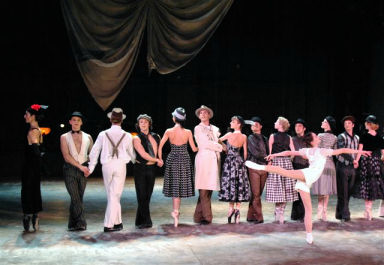
The evening began with “Solitaire” a piece that by now can almost be referred to as a classic, some 15 years after the death of its choreographer, Kenneth Macmillan. The music was composed by Malcolm Arnold – who passed away just last year and to whom the performance was dedicated. A benign little sketch on the situation of a young woman who despite her efforts to become part of a group ends up on her own, it passed quickly, thus giving way to two new productions commissioned from young Greek choreographers.
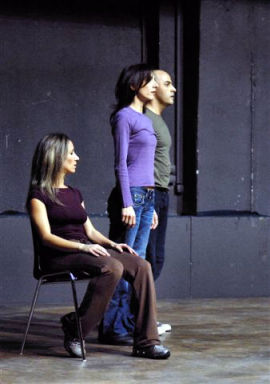
The first of these was Ioannis Mandafounis’ astonishing new vision of “L’Apres-Midi d’un Faune”. Bearing no resemblance whatsoever to the prominent types of stagings many of us have probably seen in the past, most memorably captured on film with Nureyev, this was an arresting attempt to offer a glimpse of the turmoil that may be lying underneath a smooth surface.
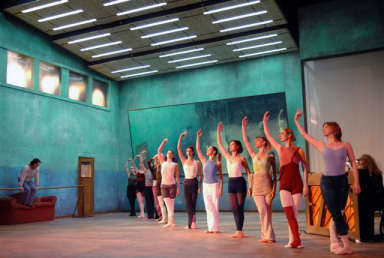
Les Sylphides The second was “Les Sylphides” by Constantinos Rigos. Set in a dance studio, Rigos’ version told the story of a ballet company – perhaps even of the GNO Ballet itself – rehearsing for a production, about the significance of artists’ external appearance, their narcissism, even exhibitionism, anorexia, etc., closing with one of the sylphides-ballerinas vomiting into a supposed backstage lavatory.
Predictably, these two didn’t find much favor among critics in the Greek press. To quote Rigos, “some members of our audience will go to see a specific ballet in order to see what they expect to see performed in a specific way.” Alas, this is typical, since reviewers in this country are so often unwilling to cut their fellow countrymen a little slack, mercilessly judging them against what is to be seen in theatres in America and “Northern” Europe. I certainly share the displeasure expressed by some about the sets – couldn’t the holes in the wall and the fire-extinguisher at the back of the stage have been covered up? But perhaps this was intentional, and I just didn’t get it. Regardless, in the case of these two new productions, I definitely applaud the courage of both choreographers to present a fresh angle rather than try to copy what has already been around (and which would inevitably involve being compared to the great masters), and for showing their audiences that dancers can tell us enthralling stories, which have much do with us and the lives we live. And let us not forget, (but since mention has been made of comparisons, please understand that I am not comparing Mandafounis to the great Nijinsky) that “L’Apres-Midi d’un Faune”, with its references to primordial sexuality, caused quite a scandal among the well-heeled Paris audience it was first presented to.
Bettina Mara
Back to the Top Back to the Index Page |
| ||
|
||||