|
|
| 
Editorial
Board
North American Editor:
(USA and Canada)
Marc
Bridle
London Editor:
(London UK)
Melanie
Eskenazi
Regional Editor:
(UK regions and Europe)
Bill
Kenny
Webmaster:
Len
Mullenger

|
Seen and Heard International
Opera Review
Ernest Bloch, Macbeth:
Soloists, Orchestra and Chorus of Oper Frankfurt,
04.01.2007 (BM)
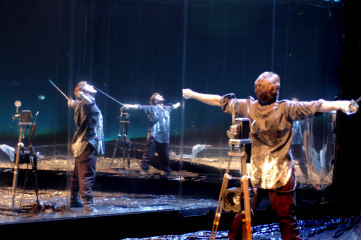
The Swiss composer’s name is reminiscent of the German
philosopher Ernst Bloch, who penned The Principle of
Hope some 30+ years after Macbeth was first
performed in 1910. And hope was one of the key ingredients
in Bloch and his librettist Edmond Fleg’s quest to see
their work on stage, finally succeeding in 1910 at the
Opéra Comique in Paris. Some might think that the two
were overly ambitious in taking on the very same Shakespearean
tragedy as Verdi had in his masterpiece only 60 years
earlier, but the Italian giant’s version was seldom performed
around the turn of the century and it is quite possible
that Bloch and Fleg were not even aware of the work.
But they were certainly aware of Freud’s new and revolutionary
theory of psychoanalysis, and it is this aspect, in keeping
with which they focused on Macbeth’s conscience rather
than his ambition, together with Bloch’s splendid orchestral
score - almost a guide to the birth of musical modernism
in its own right, with its many allusions to Janacek,
Debussy, Fauré and especially the Mahlerian brass section
- that makes their opera worth seeing. Sadly, however,
Bloch’s desire to show “Macbeth’s crime as his inexorable
fate” somehow just doesn’t come across on stage; his opera
is an admirable piece of music, but works less well as
a musical drama.
Due to the fact, at least in part, that Bloch was clearly
not as adept at composing for voices as he was at instrumental
music, it was a shame that at this performance quite a
few outstanding singers didn’t exactly have very inspiring
parts to sing – indeed, most of the time it felt like
their voices were somehow in the way of the often striking
music coming out of the orchestra pit under Martyn Brabbins.
At times I almost felt sorry for Daniel Sumegi and Taina
Piira, who both lent their substantial talents to the
roles of Macbeth and his Lady, and the brilliant chorus
(rehearsed by Alessandro Zuppardo), although especially
the latter definitely had their moments. The only member
of the cast who was allowed a truly lyrical moment was
tenor Michael McCown, who gave a moving performance as
King Duncan. This was all the more admirable since he
had taken on this role in addition to those of Lennox
and the First Apparition at the very last minute when
his colleague was taken ill, obliging him to sing Duncan
from a score - done very discreetly behind a semi-transparent
gauze curtain which actually worked very well.
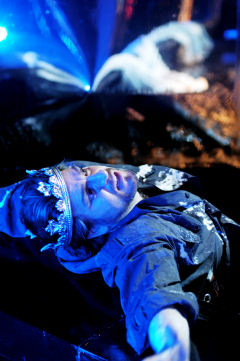
Unfortunately, renowned
British director Keith Warner’s staging did little else
to improve things: entirely in black and white (even the
blood was black, and there was no shortage of it), just
like the ubiquitous newspapers and cameras, symbolizing
the power of modern media over humble mortals? It offered
little more than a mere sequence of – albeit extraordinary
– images and made no attempt to tell the tale behind them,
leaving the audience with nothing but a diffuse feeling
of unease to go home with.
Bottom
line? At the risk of sounding sarcastic, I will say that
I did not come out of this performance desperately wishing
that Bloch had composed more than one opera, as one might
on emerging from, say, Fidelio. His three hours
of astonishing music would have perhaps worked better
as a ballet suite, without the voices superimposed on
it, but clearly that is not for me to say. Nonetheless,
if you are anywhere near Frankfurt on January 13th,
don’t miss the last performance of this production scheduled
for the current season! It’s unlikely that this piece
will be on the bill anywhere else any time soon, and besides,
a visit to Frankfurt’s avant-garde Opera House is always
worthwhile; not only because of its artistic programming,
but also thanks to its architecture, which is novel and
impressive.
The only minor fault I found with the latter this time
were the extremely high-altitude surtitles, which would
have been quite useful, even though Frankfurt’s Macbeth
features the English version of the libretto, created
after the composer emigrated to the United States in 1916,
and ostensibly prompting him to make extensive changes
to the score in order to adapt to the flow of the language.
Rather than suffer whiplash, however, I decided to make
do as we all did in the old days, understanding about
a fourth of what was sung and making up for the rest by
semi-intelligent guessing and having read the synopsis.
Bettina Mara
Pictures © Monika Rittershaus
Back to the Top
Back to the Index Page
|
|