It
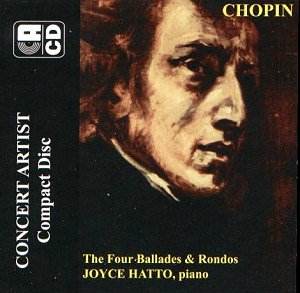
was wise to couple the curiously under-appreciated Rondos with
the canonical Ballades. Not the least of the advantages for the
listener is to experience Joyce Hatto’s acutely sensitive playing
in works often dismissed, the earlier at least, as juvenilia.
And in the case of the Ballades she shows how much poetry and
feeling can be generated by an artist stripped bare of the kind
of egotistical self-absorption that can reduce these works to
splintered refractions of outsize personality. At no time listening
to her playing of the Ballades was I conscious of a single false
or imposed moment, no pedal dampening or, conversely, romantic
wash of sound. Her rubati are natural but almost imperceptible,
the digital clarity of her playing never cold but always firmly
concentrated on releasing the essence of the musical argument.
It’s playing both honest and memorable.
Each
note tells in the G minor Ballade, a work taken by Hatto as an
arch, the mechanics of which are never paraded. There are no exaggerations,
no fancy Romanticism imposed from without but equally no little
eloquence and emotion. This is playing of sagacity and command,
playing that is both articulate and understanding of the myriad
technical and expressive complexities that lie embedded in the
music. In the F major she coalesces the moods and dramatic reflections
through a clear-eyed conception of the work’s structure. There
is a straight forwardness to her playing that, in the very best
sense, allows the piece more fully and truly to speak directly
to the listener. Her tone though remains warm and what remains
compelling is not just the seeming ease with which she unfolds
the discourse but the exceptional clarity of her passagework (you
really can hear everything in her right hand, even when she’s
playing quietly).
The
A flat Ballade is suffused with an affectionate simplicity; the
climaxes are excellently controlled, the tone never forced. In
the F minor we experience once more her perception and truthfulness.
She abjures obviously nudging rubati but knows precisely when
to reach the apex of a phrase with exquisite timing. As with all
the ballades her instincts are set toward a delineation of the
musical line unencumbered by the extraneous, by the superficial,
by the inessential.
Those
Rondos respond equally well to her rhythmic brio. She doesn’t
subject them to a greater weight of consequence than they can
withstand – especially the early C minor and the Rondo à
la Mazur from 1827. In the later two bigger works her virtuosity
and leonine power are never in doubt – and neither is the essential
truth of her playing.
These
two sets were recorded six years apart. The Rondos have a bigger
and more resonant studio acoustic than the Ballades, but whilst
not the most glamorous sound it accords well with Hatto’s own
musical precepts – directness, straightforwardness, a distillation
of experience entirely at the service of the music. A real achievement.
Jonathan
Woolf
see also JOYCE HATTO - A Pianist
of Extraordinary Personality and Promise: Comment
and Interview by Burnett
James
MusicWeb
can offer the complete
Concert Artist catalogue
 Joyce Hatto (piano)